🔐 Trezor Login —
Many new crypto users search for “Trezor Login” expecting a traditional online sign-in page like an exchange or banking website. But this is where misunderstandings — and security risks — begin.
Unlike centralized platforms, Trezor does NOT provide a login page or cloud account access. There is no username, no password, and no website where you “log in” to see your crypto.
That’s because Trezor is built for true self-custody. Your coins never sit on a server, and your private keys never touch the internet. Instead, your hardware wallet becomes your identity and security layer.
This guide explains how Trezor Login really works, how to access your assets safely, and how to avoid scams targeting beginners.
🔍 Understanding Trezor Login the Right Way
Instead of signing into a website, Trezor uses a device-based authentication process. Access to your crypto requires:
Your physical Trezor wallet
The Trezor Suite application
Your device PIN
Optional passphrase (for advanced protection)
This approach keeps your cryptocurrency offline, hack-resistant, and outside third-party custody.
❌ There Is No Web Login Page — and That’s On Purpose
With exchanges like Coinbase or Binance, you log in using an email and password.
But this also means:
Your private keys are held by the exchange
Your crypto depends on their security
Accounts can be frozen, hacked, or restricted
Trezor takes the opposite security philosophy:
TrezorOnline ExchangesNo login webpageWeb login requiredPrivate keys held by userPrivate keys held by exchangeOffline securityOnline attack exposureZero trust architectureTrust in company required
You are the only one with access to your private keys — not Trezor, not a company, not a cloud server.
🧭 The Correct Way to “Log In” With Trezor
Follow this official sequence:
1️⃣ Download and open Trezor Suite
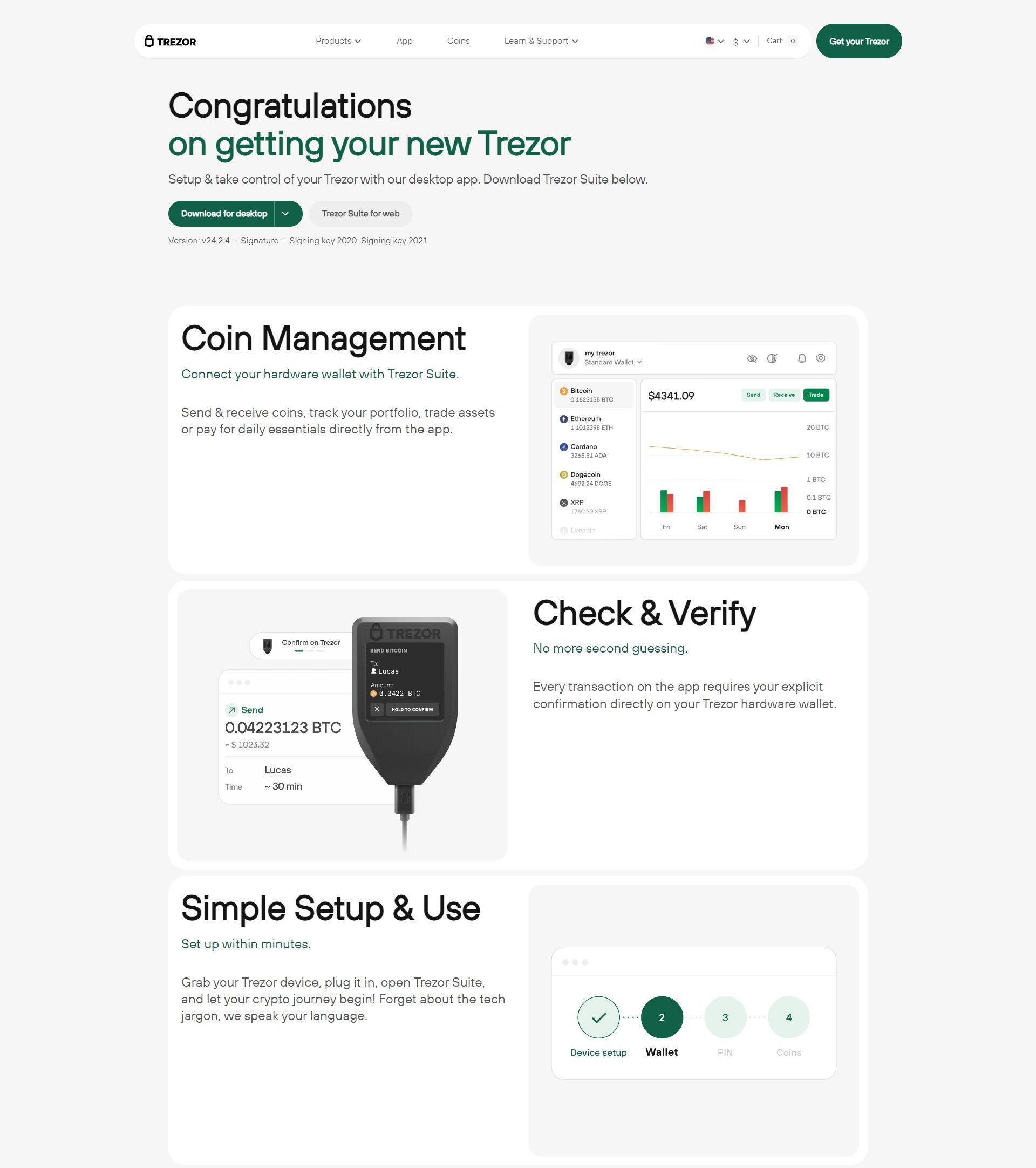
Trezor Suite is the secure interface for managing your wallet.
Desktop version is recommended for maximum protection
Download only from Trezor.io/start
2️⃣ Connect your Trezor hardware wallet
Using USB-C or micro-USB depending on your model.
Once connected, the device screen activates.
3️⃣ Enter your PIN
You enter the PIN via the Trezor device, not the computer keyboard.
This prevents keyloggers from stealing it.
Each time you connect the device, you’ll need your PIN — this is the true “Trezor login.”
4️⃣ (If enabled) Enter your passphrase
A passphrase functions as a hidden wallet layer.
It can protect assets even if the recovery seed is compromised
Each passphrase generates a unique hidden wallet
With PIN + passphrase, even physical theft becomes ineffective.
5️⃣ Access your wallet in Trezor Suite
Once authenticated, your portfolio loads in the app, where you can:
View balances
Receive funds
Send crypto securely
Swap supported coins/tokens
Manage transaction history
Everything is controlled through the hardware — not the internet.
🛡 Why the Trezor Login System Is Safer Than Web Logins
Traditional online logins are vulnerable to:
Password leaks
Data breaches
Brute-force attacks
SIM swaps
Phishing
Malware
Trezor eliminates these threats because:
It does not store sensitive information online
It requires physical hardware authentication
Private keys never leave the device
Every transaction must be manually approved on the device screen
Even if your computer is compromised, hackers still cannot move your crypto without your Trezor device and PIN.
🚨 Phishing Warning: Fake “Trezor Login” Websites
Cybercriminals target users who search the term “Trezor Login.”
They build fake login pages that ask for:
Recovery seed phrases
PIN numbers
Private keys
This is 100% theft.
⚠ Golden Rule
Trezor will never ask for recovery seed words on a website or inside Trezor Suite.
Your recovery seed should only ever be:
🟢 Displayed on the Trezor hardware wallet screen (during setup)
🔴 Never typed or entered into a computer or phone
If a website asks for your recovery seed, it is a scam — no exceptions.
👤 What If You Forget Your PIN?
You can reset the device and recover your crypto using your recovery seed — as long as it is stored safely offline.
But if you lose both:
🔻 the device and
🔻 the recovery seed
…your crypto cannot be recovered.
The seed phrase is the true key to your wallet.
🧠 Simple Way to Think About Trezor Login
Forget website logins. With Trezor, access works like this:
ComponentPurposeTrezor deviceStores private keys offlinePINFirst layer of protectionOptional passphraseAdvanced hidden-wallet securityTrezor SuitePortfolio interface — has no access to keys
You don’t log in to Trezor — you authenticate using the hardware wallet.
🏁 Final Takeaway
When you hear “Trezor Login,” think of this flow:
1️⃣ Open Trezor Suite
2️⃣ Connect your Trezor hardware wallet
3️⃣ Enter your PIN on the device
4️⃣ (Optional) Enter your passphrase
5️⃣ Manage your crypto safely inside Trezor Suite
This simple design prevents remote hacking, protects your private keys forever, and keeps full control of your crypto in your hands.